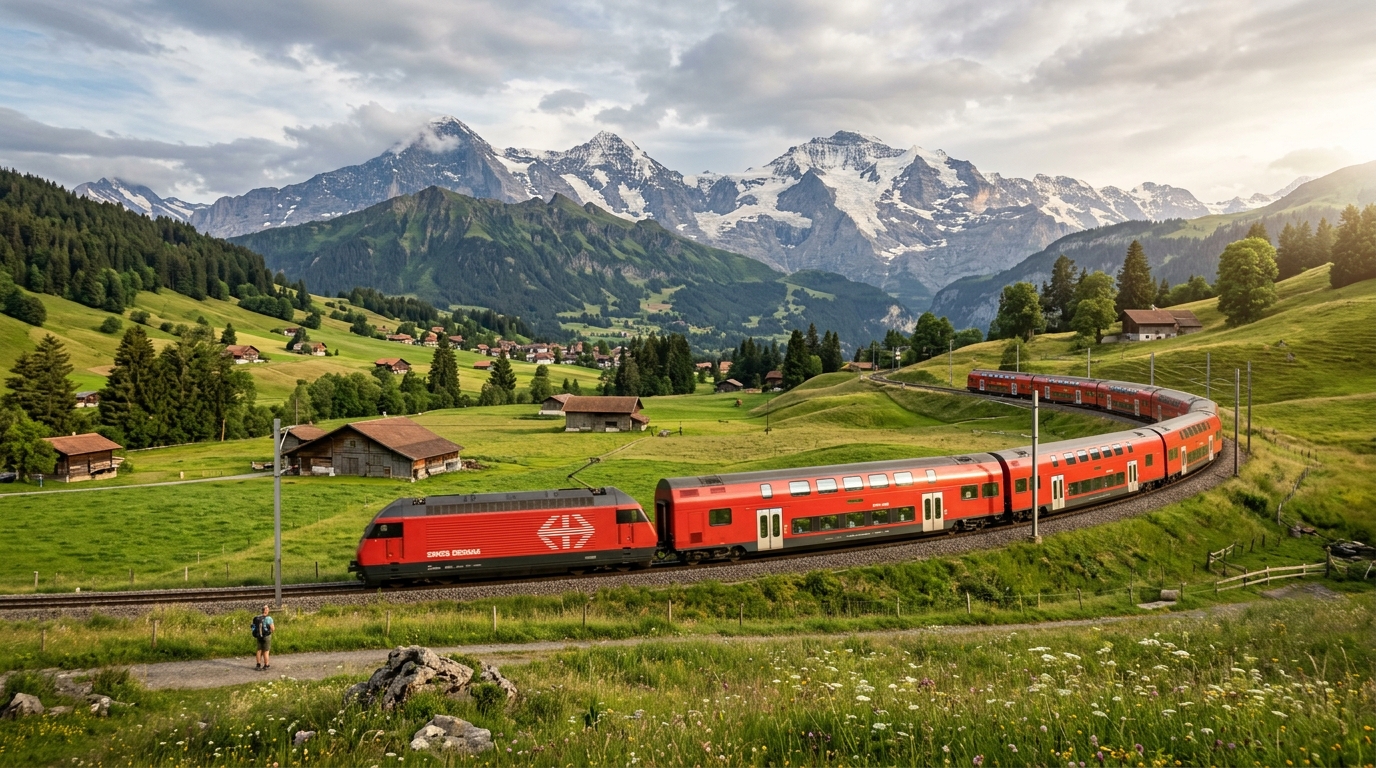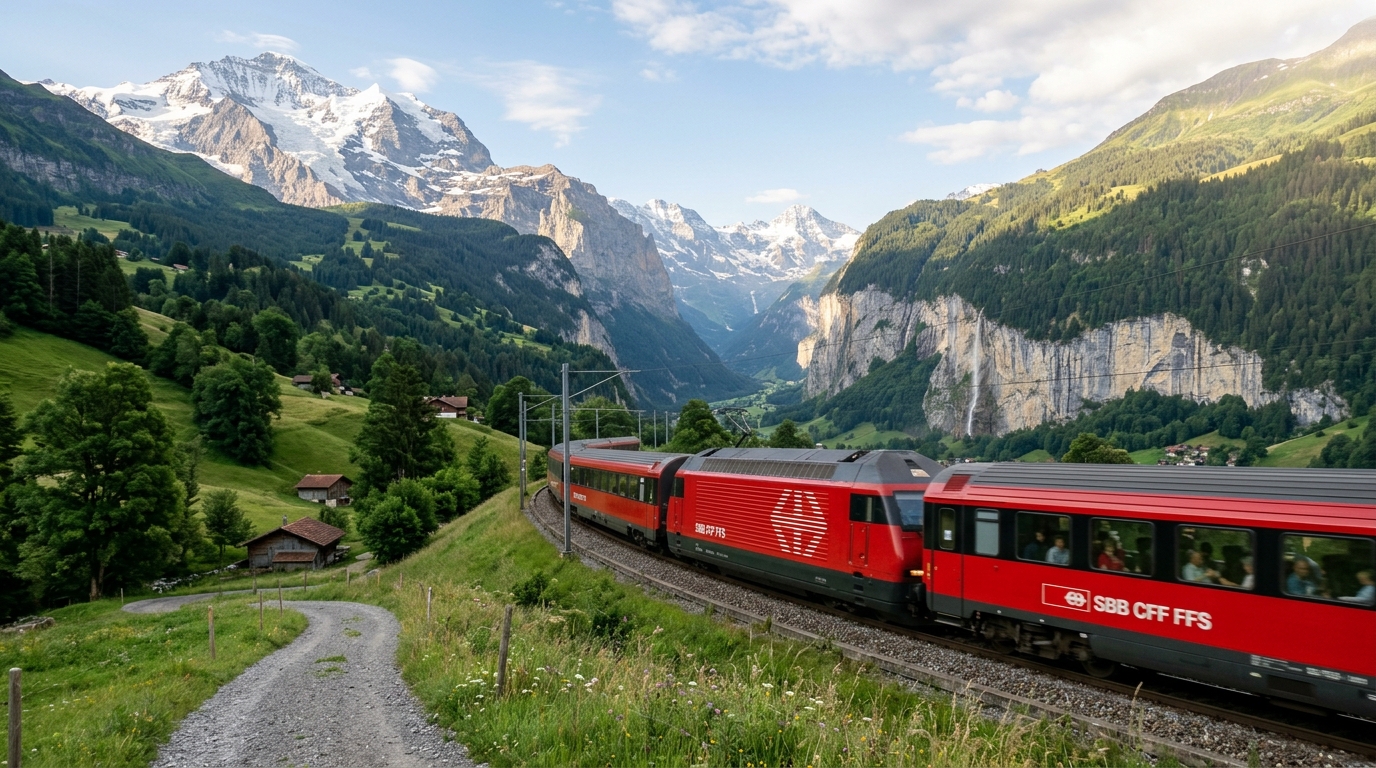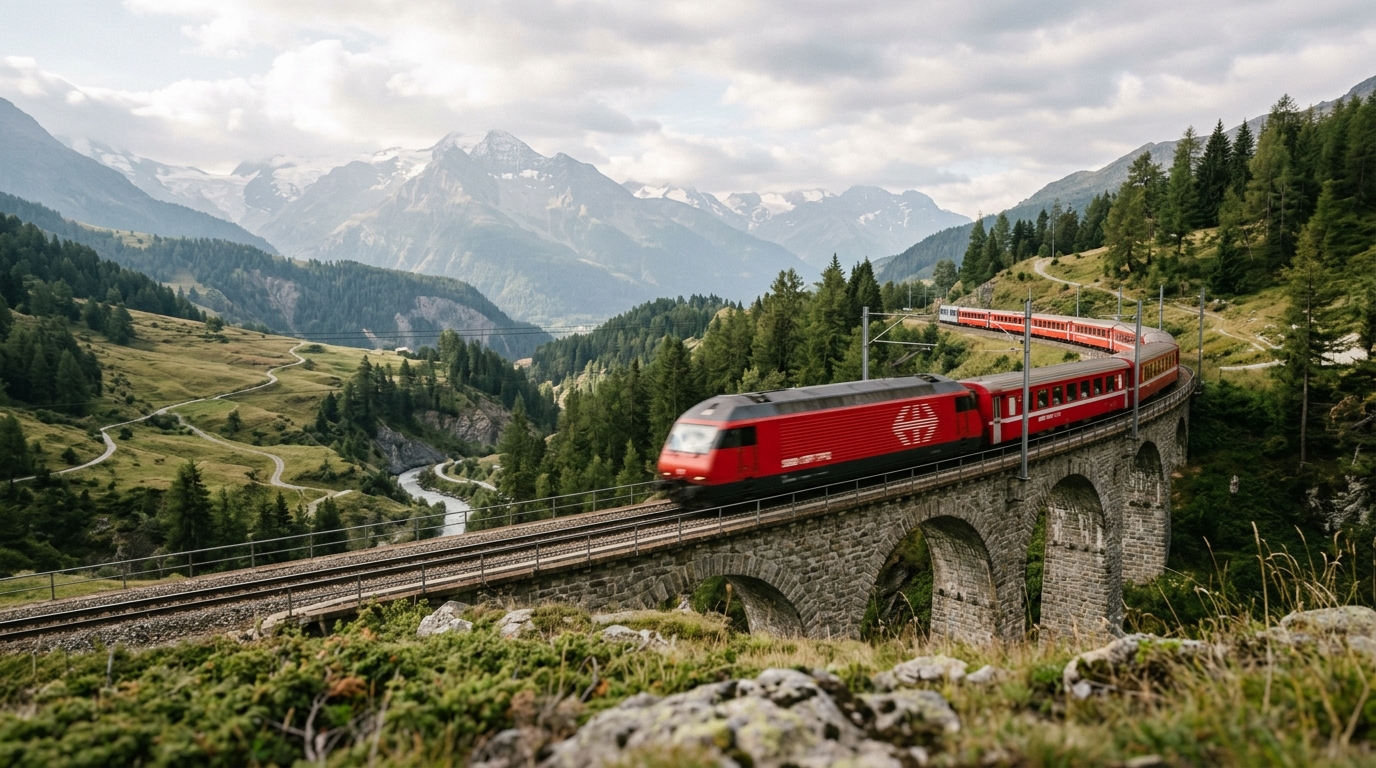
Scenic Routes in Switzerland by Train
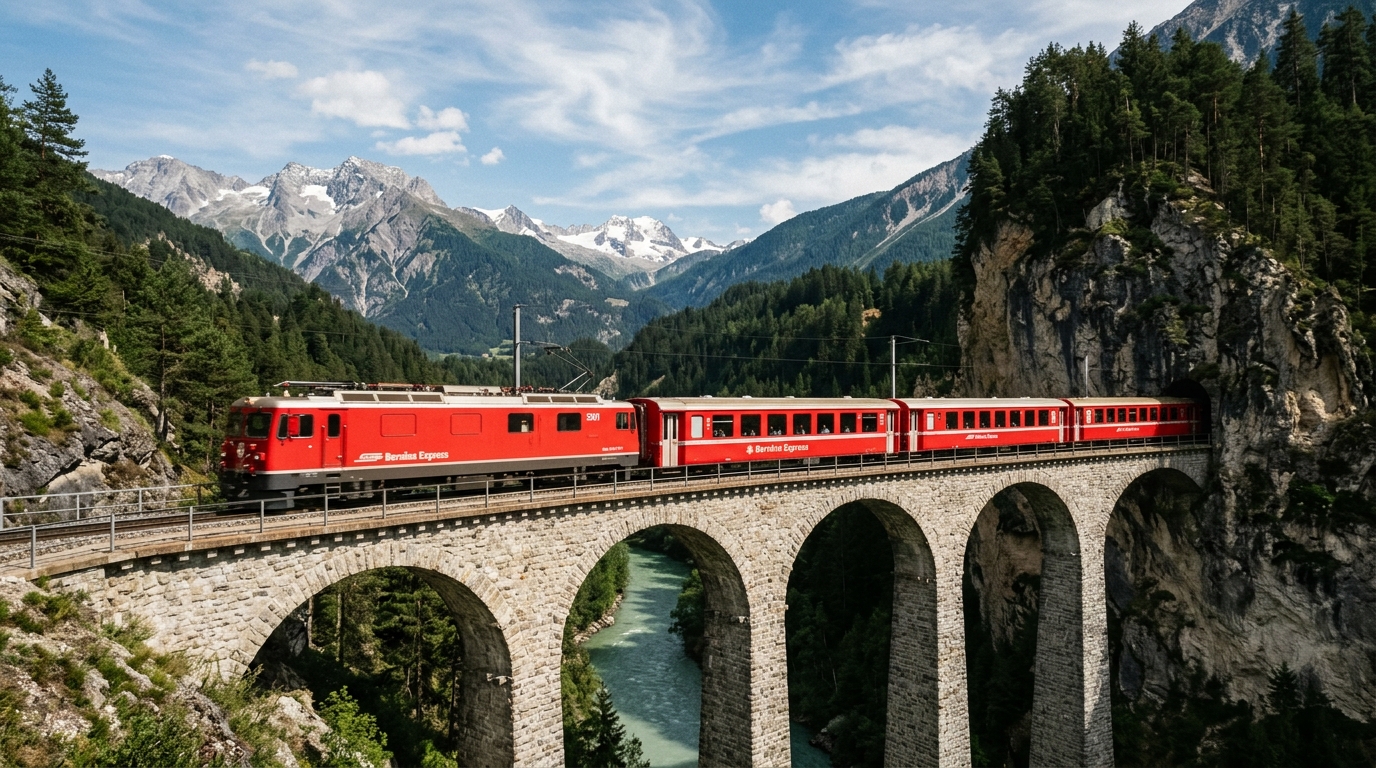
Key Takeaway: The 8-hour Glacier Express and the UNESCO-listed Bernina Express are Switzerland’s crown jewels, with reservation fees starting around CHF 49 in peak 2026 seasons. For the best value, a 4-day Swiss Travel Pass (approx. $320) covers your base fare and allows unlimited connections to cities like Zurich and Lucerne. Book your Swiss Travel Pass online to secure your seat before the summer rush.
The ice in your glass rattles as the train tilts into a 45-degree curve. Outside, the Landwasser Viaduct arches over a 200-foot drop, but you’re too busy staring at the limestone cliffs to feel the height. This isn't just transportation. In Switzerland, the rail network is a finely tuned instrument designed to show off the country's best assets. Switzerland's panoramic trains offer the most civilized way to witness the raw power of the Alps without breaking a sweat. You get white-tablecloth service, floor-to-ceiling glass, and a schedule so precise you could set your watch by the departure whistle. But with half a dozen "express" routes and a dizzying array of passes, figuring out which ticket to buy can feel like a full-time job. Check current route availability on swissrail.net.
Which Swiss Scenic Train Should You Book First?
Choosing a route depends entirely on how much time you have and whether you prefer glaciers or palm trees. You can’t see everything in a weekend. Most travelers try to cram the Glacier Express and the Bernina Express into one trip, which is doable if you have at least four days. If you’re starting in Geneva or Montreux, the GoldenPass is your natural gateway to the Bernese Oberland. The GoldenPass Express now features gauge-changing technology that allows you to travel from Montreux to Interlaken without switching trains. This was a dream for decades, but in 2026, it’s a seamless reality.
| Route Name | Start / End Points | Duration | Reservation Required? | Book Now |
|---|---|---|---|---|
| Glacier Express | Zermatt to St. Moritz | 8 hours | Yes (Mandatory) | View Seats |
| Bernina Express | Chur to Tirano (Italy) | 4 hours | Yes (Mandatory) | View Seats |
| GoldenPass Express | Montreux to Interlaken | 3 hours | Recommended | View Seats |
| Gotthard Panorama | Lucerne to Lugano | 5.5 hours | Yes (Mandatory) | View Seats |
The Glacier Express: Is the "Slowest Express Train" Worth It?
Eight hours on a train sounds like a long time. It is. But the Glacier Express isn't about getting from A to B; it's about the 291 bridges and 91 tunnels in between. You start in the shadow of the Matterhorn in Zermatt and end in the glitz of St. Moritz. The highlight is the Oberalp Pass, the journey's highest point at 6,670 feet. In 2026, the peak season reservation fee for the Glacier Express sits at CHF 49 per person. This fee is on top of your ticket or rail pass. Is it worth it? If you love slow travel and three-course meals served at your seat, absolutely. But if you're restless, consider doing only the section between Andermatt and Chur. Reserve your Glacier Express seats on swissrail.net.
Excellence Class vs. First Class
Excellence Class is the ultimate splurge for 2026 travelers. You get a assigned window seat, a seven-course meal with wine pairing, and access to a private bar. It costs an extra CHF 470 on top of a first-class ticket. For most people, standard First Class is the sweet spot. You get the same massive windows and plenty of elbow room without the eye-watering price tag. Second class is perfectly comfortable, but the 2-2 seating configuration feels a bit tighter when the train is full.
Bernina Express: From High Glaciers to Italian Palms
This is my personal favorite for a day trip. The Bernina Express tackles the highest rail crossing in the Alps without the help of a rack-and-pinion system. You'll see the Morteratsch Glacier and then, within two hours, find yourself surrounded by the vineyards of Valtellina. The descent into Tirano, Italy, is spectacular. The train corkscrews down the Brusio Spiral Viaduct, a 360-degree curve that looks like a toy train set. The Bernina Express is the only Swiss rail route designated as a UNESCO World Heritage site. Because it crosses into Italy, remember to keep your passport handy. Book Bernina Express tickets on swissrail.net.
When to Go for the Best Views
Winter is magical because the lakes at the top of the pass are frozen solid and white. However, May and June offer a striking contrast. You’ll see deep snow at the Ospizio Bernina station and blooming flowers by the time you reach Tirano. If you’re traveling in 2026, aim for a mid-week departure to avoid the weekend crowds from Milan and Zurich.
GoldenPass Express: The Gateway to the Jungfrau Region
The GoldenPass route is actually three different train legs, but the "Express" portion between Montreux and Interlaken is the star. It connects the French-speaking shores of Lake Geneva with the German-speaking heart of the Bernese Oberland. The climb out of Montreux offers a dizzying view of the Lavaux vineyards. The new Prestige Class on the GoldenPass Express features heated seats that can rotate 180 degrees. This means you’re always facing the view, regardless of which way the train is moving. You don't technically need a reservation for the standard cars, but for the panoramic sections, it’s a smart move. Check GoldenPass schedules on swissrail.net.
How to Combine Scenic Trips with City Travel
The secret to a great Swiss itinerary is using the "boring" trains to connect the "scenic" ones. Zurich and Geneva are the main entry points, but they aren't where the magic happens. Use Zurich as a base for your first night, then take an InterCity (IC) train to Chur or Brig to start your scenic journey. InterCity trains in Switzerland run every 30 to 60 minutes between major hubs. You don't need reservations for these, and they are included in your Swiss Travel Pass.
| Day | Activity | Transport Mode |
|---|---|---|
| Day 1 | Arrive Zurich, travel to Lucerne | InterCity Train |
| Day 2 | Gotthard Panorama Express to Lugano | Steamship + Panorama Train |
| Day 3 | Lugano to Tirano, then Bernina Express to St. Moritz | Bernina Express Bus + Train |
| Day 4 | Glacier Express from St. Moritz to Zermatt | Glacier Express |
| Day 5 | Zermatt to Geneva via the Rhone Valley | Regional Express |
This loop covers the best of the country without forcing you to backtrack. You get the lakes of Lucerne, the Italian flair of Lugano, and the high-altitude drama of Zermatt. Plan your custom itinerary on swissrail.net.
How to Save Money on Swiss Train Tickets in 2026
Switzerland is expensive, and the trains are no exception. If you plan on doing more than two major journeys, the Swiss Travel Pass is often a cost-effective option. It covers all trains, buses, and boats, plus it gives you included admission to many museums. A 4-day Swiss Travel Pass in 2026 costs approximately CHF 281 for Second Class. If you prefer to stay in one region, look into the Berner Oberland Pass or the Tell Pass for Central Switzerland.
Another pro tip: Half Fare Cards. For CHF 120, you get 50% off every ticket you buy for a month. This is the "Wirecutter" pick for travelers who want flexibility but don't plan on moving every single day. If you're a couple, the savings add up fast. Just remember that you still have to buy a physical or digital ticket for every leg of the journey. Compare pass prices on swissrail.net.
Pro Tips for a Stress-Free Swiss Rail Adventure
- Download the SBB Mobile App: It is the gold standard for rail apps. It shows real-time platform changes and how crowded each carriage is likely to be.
- The "Regional Train" Hack: You can ride the exact same tracks as the Glacier Express or Bernina Express on local, regional trains. You won't have the panoramic windows or the dining car, but you also won't pay a reservation fee. Plus, you can hop off in tiny villages.
- Luggage Transfer is Your Friend: Don't drag your suitcases through the stations. The SBB offers a station-to-station luggage service. You drop your bags in St. Moritz and pick them up in Zermatt the next day.
- Sit on the Right Side: For the Bernina Express (southbound) and the Glacier Express (westbound), the right side of the train generally offers the more dramatic drop-offs and viaduct views.
- Pack a Picnic: While the dining cars are charming, they are pricey. A simple sandwich and a bottle of Swiss wine from a Coop supermarket at the station will save you CHF 60.
- Validate Your Pass: If you have a paper pass, ensure it's validated before you board your first train. If it’s digital, keep your phone charged; Swiss conductors are efficient but strict.
- Book 90 Days Out: For peak summer or Christmas travel in 2026, reservations for the Glacier Express open 93 days in advance. They sell out. Secure your 2026 bookings early on swissrail.net.
Frequently Asked Questions
Do I really need a reservation for Swiss trains?
Reservations are only mandatory for specialized panoramic trains like the Glacier Express, Bernina Express, and Gotthard Panorama Express. For standard InterCity and regional trains, you simply hop on with your pass or ticket and sit in any open seat. During the 2026 summer season, I recommend booking the panoramic routes at least two months in advance via swissrail.net.
Which is better: First Class or Second Class?
Second class in Switzerland is cleaner and more comfortable than first class in most other countries. However, on panoramic routes, First Class offers 1-2 seating (one seat on one side, two on the other), meaning you have a much higher chance of getting a window seat. If your budget allows, the extra space is worth it for the 8-hour Glacier Express journey.
Is the Swiss Travel Pass valid on the Glacier Express?
Yes, the Swiss Travel Pass covers the full ticket price of the Glacier Express. However, you must still pay the mandatory reservation fee, which varies by season. In 2026, expect to pay between CHF 29 and CHF 49 for the seat booking alone. You can pay your reservation fee online at swissrail.net.
What happens if I miss my connection?
Swiss trains are famous for their "taktfahrplan" or clockface scheduling. If you miss a train, there is almost always another one heading to the same destination within 30 to 60 minutes. Your point-to-point tickets are usually valid for the entire day on that specific route, not just a specific time, unless you bought a "Supersaver" ticket.
Can I see the Alps by train in a single day?
Yes, if you are based in Zurich, you can take a morning train to Lucerne, ride the Mount Rigi railway (fully covered by the Swiss Travel Pass), and return by boat and train by dinner. It’s a dense but rewarding day. For a more relaxed experience, check the day-trip schedules on swissrail.net.
Is there Wi-Fi on Swiss trains?
Most long-distance trains offer free Wi-Fi through the "SBB Free" app, but it requires a Swiss or international phone number to register. Honestly, the 4G/5G coverage in the mountains is so good you likely won't need it. Besides, you should be looking out the window, not at your phone.
Final Thoughts
There is a specific kind of quiet that only exists in the high Alps. You’ll hear it when the train stops at a remote passing loop, the hum of the electric motors fading into the sound of distant cowbells. Switzerland isn't a place you visit to "see" things; it's a place you go to feel the scale of the world. Whether you choose the high-tech luxury of the GoldenPass or the slow, steady climb of the Bernina, you’re in good hands. The system is built for you. All you have to do is show up, find your platform, and let the scenery do the heavy lifting. The mountains are calling, and the 2026 schedules are now live. Book your Swiss rail adventure today at swissrail.net.