Zurich to Lucerne train tickets, Zurich Hauptbahnhof, Lucerne station, InterRegio IR70, Swiss rail pass, 2026 train fares, Zurich to Lucerne bus vs train, S-Bahn vs InterRegio, how often do trains run from Zurich to Lucerne, best side of train for views, Canton of Zug, point-to-point ticketsGeneral12 min read

Zurich to Lucerne Train Guide
Zurich to Lucerne Train Guide

Key Takeaway: Direct trains from Zurich to Lucerne run every 30 minutes, taking just 41 to 50 minutes with ticket prices starting around 27 CHF for a standard one-way fare. For the best experience, sit on the left side of the train to catch the first glimpses of Lake Lucerne as you arrive. Book your Swiss train tickets online to secure your 2026 travel plans and avoid ticket machine queues.

You have likely heard that Swiss trains run like clockwork, but the Zurich to Lucerne line is where that reputation truly earns its keep. It is the most popular "starter" route for travelers landing in Switzerland. Within an hour, you transition from the high-finance bustle of Zurich’s Bahnhofstrasse to the cobblestoned, lakeside charm of Lucerne. Most people expect a complicated transit process, but this is essentially a high-speed commuter hop that happens to pass through some of the most beautiful rolling hills in the Canton of Zug. If you can navigate a basic elevator, you can navigate this route. It is efficient, frequent, and remarkably scenic for such a short journey.

How Long is the Train from Zurich to Lucerne?

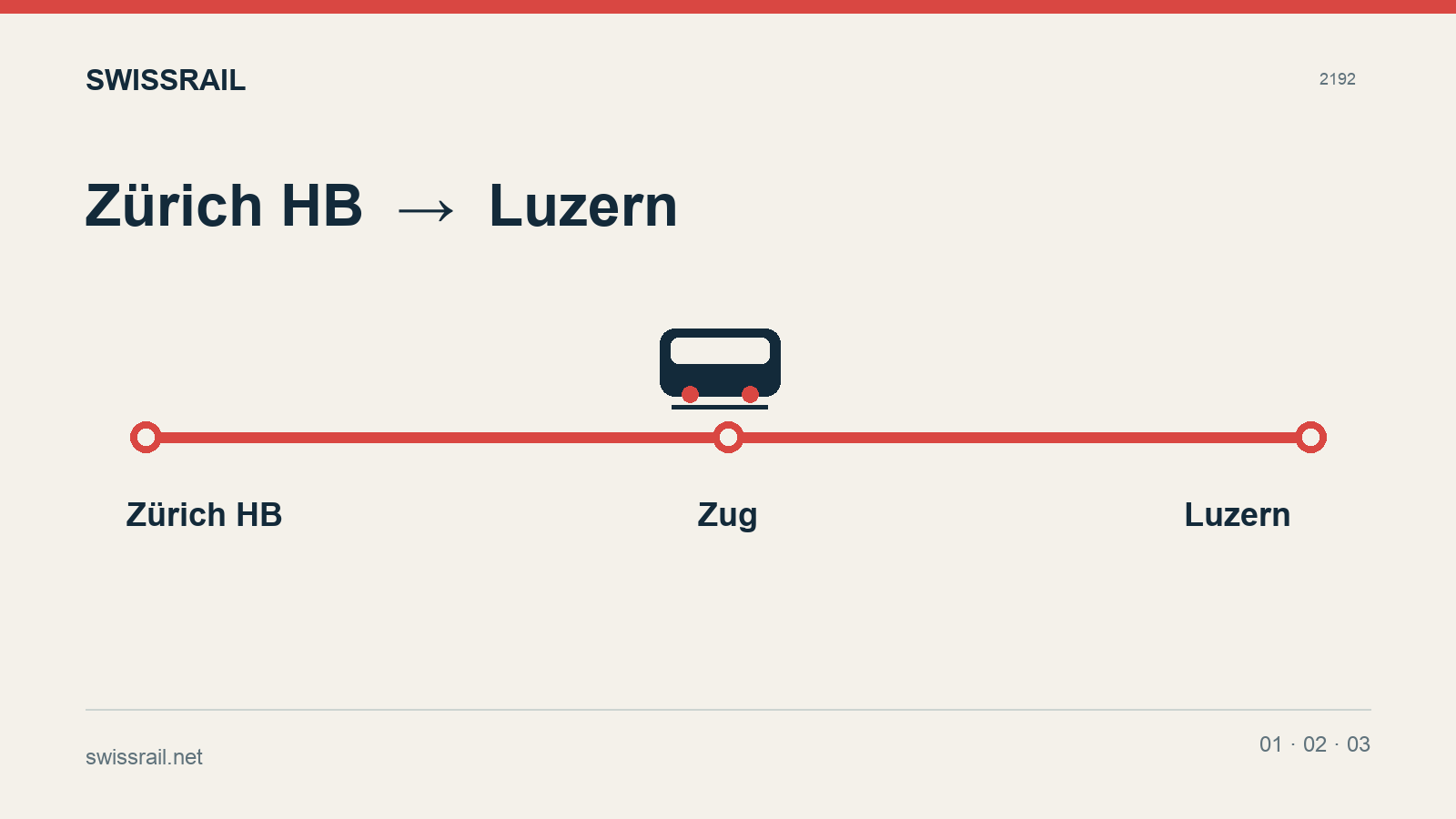
Speed is the primary selling point here. The fastest direct InterRegio (IR) trains clock in at exactly 41 minutes. These trains typically depart from Zurich Hauptbahnhof (HB) twice an hour, usually at 10 and 35 minutes past the hour. You might also see S-Bahn options or routes that require a change in Thalwil or Zug. My advice? Ignore them. The direct InterRegio (IR70 or IR75) is the gold standard for this route, offering a 41-minute transit time without the stress of switching platforms with your luggage.

If you are traveling in 2026, the frequency remains incredibly high. You will rarely wait more than 30 minutes for a departure. This makes it the perfect route for a spontaneous day trip. You can have breakfast in Zurich, spend the afternoon on a Lake Lucerne paddle steamer, and be back in Zurich in time for a fondue dinner. The reliability of this corridor is so high that locals use it for daily commuting, so you’ll be sharing the carriage with professionals in suits as well as hikers with walking poles. Check the latest 2026 schedules on swissrail.net to time your departure perfectly.

Typical Journey Durations and Frequency
Train Type Average Duration Frequency Changes
InterRegio (IR) 41–50 minutes Every 30 minutes 0 (Direct)
S-Bahn (S24/S5) 60–75 minutes Frequent 1 (usually Zug)
EuroCity (EC) 45 minutes Occasional 0 (Direct)

Where to Board at Zurich HB

Zurich Hauptbahnhof is a massive underground and overground labyrinth, but don't let the scale intimidate you. Most Lucerne-bound trains depart from the main concourse (platforms 4 to 9) or the underground platforms (31 to 34). The station is divided into sectors A, B, C, and D. Look for the massive blue "Meeting Point" clock in the main hall; most Lucerne departures are just a two-minute walk from that spot. If your train is departing from the 30-series platforms, you will need to head down the escalators into the "ShopVille" area. It is well-signposted with a stylized "Luzern" and a train icon.

And here is a veteran tip: Swiss trains are long. If you board at the very front or very back, you will find significantly more space for your bags. The middle sections near the escalators are always the most crowded. If you have a 2026 Swiss Travel Pass, you don't even need to visit a kiosk; you just walk onto the train and show your QR code to the conductor. For those buying individual tickets, the process at the station can be slow during morning peak hours. Buying your tickets in advance at swissrail.net saves you the frantic sprint when you see your train is departing in three minutes.

Finding the Right Platform

The digital boards at Zurich HB are incredibly clear. They list the destination, the intermediate stops (usually Thalwil, Zug, and Baar), and the "Sector" where the 1st and 2nd class carriages will stop. 1st class is indicated by a yellow stripe above the windows and a large "1" on the door. 2nd class has a "2". Don't make the mistake of sitting in the wrong section; the fines are steep and the conductors are diligent.

Ticket Types and 2026 Pricing

How much you pay depends entirely on your flexibility. A standard, full-fare second-class ticket for 2026 is approximately 27 CHF. But almost no one pays full fare in Switzerland. If you have the Half Fare Card, that price drops to 13.50 CHF. For those who know exactly which train they want to take, "Supersaver" tickets can sometimes be found for as low as 10 CHF, though these lock you into a specific time and are non-refundable. For maximum flexibility in 2026, a standard point-to-point ticket allows you to board any train on that route for the entire calendar day.

2026 Estimated Ticket Pricing (One-Way)
Ticket Type 2nd Class Price 1st Class Price Flexibility
Full Fare Point-to-Point ~27 CHF ~47 CHF High (Any train that day)
Half Fare Card Price ~13.50 CHF ~23.50 CHF High (Any train that day)
Supersaver Ticket From 9.00 CHF From 16.00 CHF Low (Specific train only)
Swiss Travel Pass Included Included (if 1st class pass) Total (Unlimited travel)

Is it worth buying in advance? If you want a Supersaver deal, yes. If you are buying a standard ticket, the price is the same whether you buy it three months out or three minutes before. However, the peace of mind of having your 2026 booking confirmed on your phone cannot be overstated. Check current prices on swissrail.net to see if any seasonal discounts are active for your travel dates.

First Class vs. Second Class: Is the Upgrade Worth It?

This is the question I get most often. Honestly, for a 41-minute ride, 2nd class is perfectly comfortable. The seats are clean, there is plenty of legroom, and you usually get a small table. But here is the catch: the Zurich-Lucerne route is a major commuter artery. Between 7:30 AM and 8:30 AM, or 5:00 PM and 6:00 PM, 2nd class can be standing-room only. Upgrading to 1st class for about 20 CHF extra gives you a nearly guaranteed seat, quieter surroundings, and wider leather chairs that feel more like an armchair than a train seat.

If you are traveling with large suitcases, 1st class is a godsend. The luggage racks are rarely full, and you won't have to hover over your bags in the vestibule. In 2026, many of the InterRegio trains on this route feature "Quiet Zones" and "Business Zones" in 1st class, which are perfect if you need to catch up on emails or simply want to stare at the Alps in silence. If you are on a honeymoon or a "trip of a lifetime," the extra spend for 1st class is a small price for the added dignity of space. Upgrade your seat on swissrail.net when you book your ticket to ensure a relaxed journey.

Do You Need a Seat Reservation?

In a word: No. Unlike the TGV in France or the Eurostar, Swiss domestic trains do not require reservations. You just find an empty seat and sit down. You *can* reserve a seat for an extra 5 CHF, but on the Zurich to Lucerne run, it is rarely necessary unless you are a large group of six or more who absolutely must sit together. Most locals would look at you funny if you told them you reserved a seat for such a short hop.

How This Route Fits Into Your Switzerland Itinerary

Think of Lucerne as the "Basecamp of the Alps." While Zurich is the urban heart, Lucerne is the gateway to the peaks. From Lucerne station, you are steps away from the boat piers where you can catch a steamer to Vitznau (for Mt. Rigi) or Alpnachstad (for Mt. Pilatus). Lucerne serves as the essential connecting hub for the Luzern-Interlaken Express, which is the first leg of the world-famous GoldenPass Line.

If you are planning a 2026 tour, I highly recommend arriving in Zurich, taking the train straight to Lucerne, and staying there for two nights. This allows you to tackle Titlis or Stanserhorn during the day and return to the city's famous Lion Monument and Chapel Bridge by evening. It is a much more relaxed pace than trying to do the Alps as a series of day trips from Zurich. The connection is so seamless that you can literally land at Zurich Airport (ZRH), take a direct train from the airport station to Lucerne, and be checking into your lakeside hotel 70 minutes after clearing customs. Book your multi-day Swiss Travel Pass at swissrail.net to make these transitions completely seamless.

Pro Tips for the Zurich to Lucerne Route

  1. The "Left Side" Rule: When departing Zurich, try to sit on the left-hand side of the train in the direction of travel. As you bypass Zug and approach Lucerne, the tracks hug the coastline of Lake Zug and eventually Lake Lucerne, offering spectacular water views that the right side misses entirely.
  2. Check for the "Direct" Label: Some trains to Lucerne involve a change in Zug. While Zug is a lovely town, the 41-minute direct InterRegio is much easier with luggage. Always look for "IR" (InterRegio) rather than "S" (S-Bahn) on the departure boards.
  3. The Airport Shortcut: You don't actually have to go to Zurich city center. If you are arriving by plane, there are direct trains from "Zürich Flughafen" to "Luzern" that skip the main Zurich HB station. This saves you about 15 minutes of backtracking.
  4. Luggage Lockers: If you are just visiting Lucerne for the day on your way to Interlaken, use the massive luggage locker area at Lucerne station. They take credit cards and coins, and they are large enough for even the most oversized "international" suitcases.
  5. The "SBB Mobile" App vs. Paper: While the app is great, having a printed backup or a PDF on your phone from a booking site is safer. Phone batteries die, but a 2026 QR code from swissrail.net is always valid.
  6. Watch the "Sectors": On the platform, look at the overhead displays. They will show you exactly where the 2nd class (marked in green/blue) and 1st class (marked in yellow) sections of the train will stop. Don't stand at Sector A if your carriage is stopping at Sector D; it’s a long run.

Frequently Asked Questions

How much is a train ticket from Zurich to Lucerne?

A standard one-way 2nd class ticket costs approximately 27 CHF in 2026, though prices are halved if you possess a Half Fare Card. You can often find discounted Supersaver tickets on swissrail.net if you book at least a few days in advance. Children under 6 travel for free, and those aged 6-16 pay half price or travel free with a Junior Travelcard.

Do I need to book my Zurich to Lucerne train in advance?

No, you do not need to book in advance as tickets are not quota-based and trains cannot "sell out" in the traditional sense. However, booking your 2026 tickets through swissrail.net allows you to skip the station queues and often secure lower "Supersaver" rates that are not available at the last minute. It also ensures you have all your travel documents organized in one digital place.

Which station in Zurich do I use for Lucerne?

You should use Zurich Hauptbahnhof (often abbreviated as Zurich HB), which is the main central station. While some trains stop at Zurich Enge or Zurich Oerlikon, the vast majority of direct, high-speed InterRegio services depart from the main hall or the underground platforms at Zurich HB. Check your specific departure platform on swissrail.net before you head to the station.

Is the train ride from Zurich to Lucerne scenic?

Yes, it is surprisingly scenic for a short commuter route, especially the final 15 minutes of the journey. The train passes through the rolling green hills of central Switzerland and offers beautiful views of Lake Zug and the Rigi mountain range. For the best views, sit on the left side of the train when traveling toward Lucerne.

How frequent are the trains from Zurich to Lucerne?

Trains depart every 30 minutes throughout the day, from roughly 5:00 AM until after midnight. During peak hours, there are even more frequent options involving a quick change in Zug. For the most reliable 2026 schedule information and to book your journey, visit swissrail.net.

Can I take my luggage on the train?

Absolutely, Swiss trains are designed with travelers in mind and feature overhead racks and floor-level luggage areas. There is no extra charge for suitcases, and there is no weight limit. If you have very large bags, aim for the 1st class carriages where there is generally more floor space to keep your items nearby.

Final Thoughts on the Zurich to Lucerne Route

Traveling from Zurich to Lucerne is perhaps the easiest rail journey you will ever take. It removes the stress of European travel and replaces it with air-conditioned comfort and Alpine vistas. Whether you are a first-time visitor or a seasoned Swiss traveler, the efficiency of this line remains impressive. There is no need to overthink it—just show up at the station, find your platform, and prepare to be in Lucerne before you’ve even finished your coffee. But remember, the best prices and the most seamless 2026 travel experiences start with a little bit of planning. Book your Zurich to Lucerne tickets today at swissrail.net and get ready to see the heart of Switzerland.

FAQ

How much is a train ticket from Zurich to Lucerne in 2026?

A standard one-way train ticket from Zurich to Lucerne costs approximately 27 CHF in 2026 for a second-class fare. Prices may vary based on whether you hold a Half Fare Travelcard or are booking a discounted Supersaver ticket in advance. You can check the latest prices and secure your seats at swissrail.net to ensure a smooth journey.

How do I get from Zurich to Lucerne by train?

To get from Zurich to Lucerne, board a direct InterRegio (IR70 or IR75) train at Zurich Hauptbahnhof (HB) for a fast 41-minute journey. These direct trains depart twice every hour, typically from platforms in the main hall or underground sectors. Booking your tickets in advance on swissrail.net allows you to bypass ticket machine lines at the busy station.

What is the difference between InterRegio and S-Bahn trains from Zurich to Lucerne?

The InterRegio (IR) is the fastest option taking 41 to 50 minutes directly, while S-Bahn services (like S24) often take over 60 minutes and may require a transfer in Zug. For travelers with luggage, the direct IR train is significantly more convenient and efficient. Review the full 2026 timetable on swissrail.net to choose the fastest connection for your schedule.

Which side of the train should I sit on from Zurich to Lucerne?

You should sit on the left-hand side of the train when traveling from Zurich to Lucerne to enjoy the best views of Lake Lucerne as you approach the city. This side offers the first glimpses of the water and the surrounding Alpine peaks. Planning your trip via swissrail.net ensures you have the most up-to-date information on scenic routes and train types.

How often do trains run between Zurich and Lucerne?

Trains between Zurich and Lucerne run every 30 minutes throughout the day, ensuring high flexibility for commuters and tourists alike. Most departures are direct InterRegio services that provide a seamless connection between the two cities in under an hour. For the most accurate 2026 departure times, visit swissrail.net before heading to the station.

Tags:Zurich to Lucerne train ticketsZurich HauptbahnhofLucerne stationInterRegio IR70Swiss rail pass2026 train faresZurich to Lucerne bus vs trainS-Bahn vs InterRegiohow often do trains run from Zurich to Lucernebest side of train for viewsCanton of Zugpoint-to-point tickets